
TL;DR
To advertise a party rental business in California, run Google Search Ads for ready-to-book customers and Meta Ads for early planners. Time spending around graduations, summer and holidays, target only the cities you deliver to, send clicks to item-and-city landing pages, and track booked rentals, not just clicks.
Key takeaways
- Raise budgets three to four weeks before graduation, summer and holiday peaks, then cut them after.
- Give each delivery city its own ad group with the city name in the headline.
- Check the search terms report weekly and add negative keywords like free, cheap and jobs.
- Send each ad to a page showing the same item, with a tap-to-call button and date check.
- Track phone calls and quote forms, then compare them to your booking calendar weekly.
To get booked with paid ads, a California party rental company runs Google Ads for people searching right now, Meta Ads for people planning ahead, and sends both to a page that matches the event and the city. That is the short version of how to advertise party rentals in California. The rest of this guide shows how to time it, target it and measure it.
- How to advertise party rentals in California around peak seasons
- Google Ads vs Meta Ads for rentals
- Target cities you can actually deliver to
- Search terms that bring bookings
- Ad extensions and landing page match
- Tracking booked rentals
- Common mistakes
- Where to start this week
How to advertise party rentals in California around peak seasons
Party rental demand moves in waves. Graduation season in late spring, summer birthdays and backyard parties, and the holiday stretch each bring a different kind of customer. If you run the same ads all year, you waste money in slow weeks and run out of room in busy ones.
Plan around your calendar, not the ad platform’s. Your bounce houses, tables, chairs and tents can only be booked once per weekend. When your inventory is full, extra ad spend only creates leads you have to turn away.
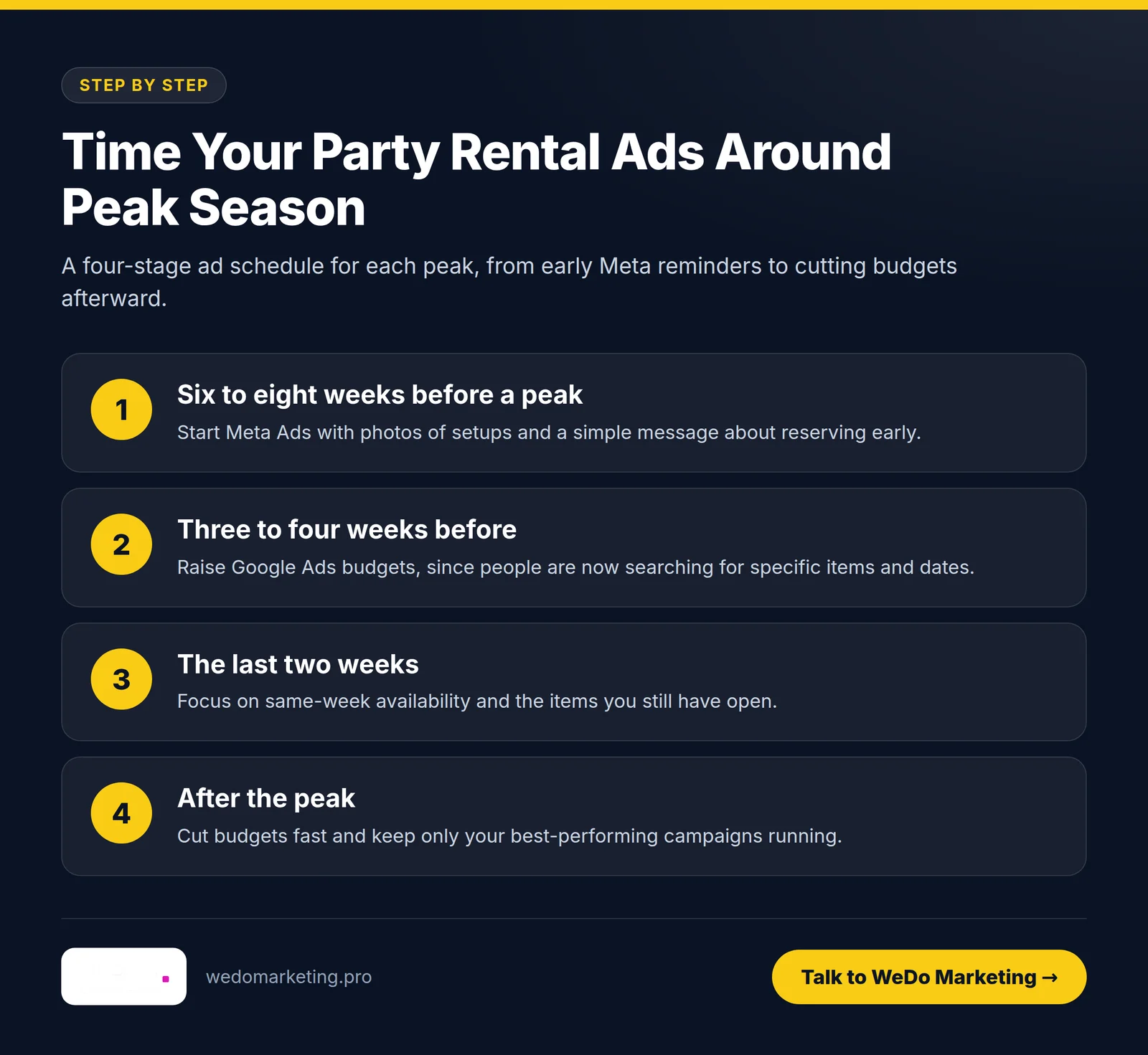
- Six to eight weeks before a peak: start Meta Ads with photos of setups and a simple message about reserving early.
- Three to four weeks before: raise Google Ads budgets, since people are now searching for specific items and dates.
- The last two weeks: focus on same-week availability and the items you still have open.
- After the peak: cut budgets fast and keep only your best-performing campaigns running.
Graduations tend to book early because families lock in tents and chairs. Holiday parties often come in as quick requests. Write different ads for each, because the buyer’s urgency is different.
Google Ads and Meta Ads do different jobs
Google Ads catches people who already want a rental. Someone types a search, sees your ad and calls. Meta Ads (Facebook and Instagram) reaches parents and event planners who have not started looking yet, so it works more like a reminder with great photos.
| Platform | Customer mindset | Best use for a rental company |
|---|---|---|
| Google Search Ads | Ready to book now | Bounce house, tent, table and chair searches in your cities |
| Meta Ads | Planning, not searching yet | Setup photos, themed packages, early graduation reminders |
| Google Business Profile | Comparing local options | Photos, reviews and the Map listing (covered in our local SEO guidance) |
If you have to pick one first, start with Google Search. The intent is clearer and you can see which searches lead to calls. Add Meta once your booking page is working.
Target the cities you can actually deliver to
Your delivery radius is your real market. A rental company in San Diego should not pay for clicks from Los Angeles if the drive makes the job unprofitable. Set your ad locations by city or ZIP code, not by a wide county circle.
Start with the three to five cities closest to your warehouse. Give each city its own ad group so the headline can say the city name. Someone in Irvine clicks faster on “Bounce House Rental in Irvine” than on a general California ad.
In Google Ads, check the location setting that targets people in your area, not people who are only interested in it. Otherwise, a family in another state planning a visit may click and cost you money.
In Meta Ads, use a radius around your delivery zone and keep it tight. Exclude areas where you charge a heavy delivery fee unless you want those jobs.
Search terms that bring bookings, and ones that waste money
Good search terms name the item, the city, or the event. Weak ones are broad and attract people who want to buy, borrow or work for you.
Terms worth bidding on
- Bounce house rental near me
- Table and chair rental plus city name
- Graduation tent rental
- Water slide rental plus city name
- Party rental delivery plus city name
Terms to block with negative keywords
- Free, cheap, DIY
- For sale, buy, used
- Jobs, hiring, franchise
- Wholesale, supplier
Check your search terms report every week during a peak season. You will find searches you never planned for, and some will be gold, like a specific item you carry that you forgot to mention in ads. Others will drain budget until you add them as negatives.
Ad extensions and landing page match
Extensions make your ad larger and give people more reasons to tap. Use call extensions so parents can phone you from their phone. Add sitelinks to your top items, such as bounce houses, tents and tables. Add location information if you have a yard or showroom, and add short callouts like “Delivery and setup included” only if it is true.
Then comes the part many owners skip: the page the ad sends people to. If someone clicks “Graduation Tent Rental in Fresno,” they should land on a page about tents for graduations, not your home page with fifty products.
A matching page has these basics:
- The same item and city named in the headline
- Real photos of your own setups
- A clear way to check a date and request a quote
- A tap-to-call button that works on a phone
- Delivery area and what is included, in plain words
A good website and landing page built for mobile makes a big difference, since most parents will look at your ad on their phone while doing something else.
When the ad promises an item and the page shows that same item with a date field, the visitor does not have to hunt for it. For examples of how this looks in practice, see our party rental case studies.
Tracking booked rentals, not just clicks
Clicks do not pay your bills. Booked rentals do. Set up tracking so you know which ad led to which job.
- Track calls: use call tracking from your ad account so you can see which campaign drove each phone call.
- Track forms: count every quote request as a conversion, and mark the ones that become paid orders.
- Ask on every call: add “How did you hear about us?” to your phone script.
- Match to your calendar: once a week, compare booked jobs against ad leads in a simple spreadsheet.
Your cost per booked rental is the number that matters. A cheap lead that never books is more expensive than a pricey lead that does.
Common mistakes with party rental ads
Mistake 1: Running ads all year at one budget
Match spend to graduation, summer and holiday demand. Pause or reduce in slow weeks.
Mistake 2: Sending every click to the home page
Use item and city pages so the visitor sees what they searched for within a second.
Mistake 3: Ignoring missed calls
A parent planning a party rarely leaves a voicemail. They call the next company. Answer fast, or return the call the same hour.
Mistake 4: Advertising items you cannot deliver
Do not promote a weekend date you already filled. Update ads when inventory runs out.
Frequently Asked Questions
How do I advertise party rentals on a small budget?
Start with Google Search Ads for your top three items in your closest three cities. Searchers are ready to book, so fewer clicks are wasted. Keep a tight negative keyword list and pause campaigns when your calendar is full. Add Meta Ads only after your landing page and call tracking work.
Do I need a business license for a party rental business in California?
Requirements vary by city, county and what you rent, so check with your local city hall and a tax professional before your first booking. This guide covers advertising, not licensing.
Are party rentals profitable?
It depends on your equipment costs, delivery distance, labor and how often your inventory is booked. Ads can help fill open weekends, but only profit per booked rental tells you if it works. Track cost per booking and delivery time on every job before you scale spending.
Should I use Facebook or Google to advertise party rentals?
Use both for different jobs. Google reaches people actively searching for a rental, so it usually brings faster bookings. Facebook and Instagram work well for showing setup photos to parents planning ahead. If you start with one, begin with Google Search.
Where to start this week
Pick your next peak season, choose your three closest cities, and write one ad group per city for your top three items. Build or fix one landing page that matches, and set up call and form tracking before you spend a dollar. If you want a team to build and manage this for you, talk to WeDo Marketing about paid traffic for your rental business.
Leave a Reply